


High Fashion on Ice: When Couture Entered The Olympic Rink

Vera Wang, Christian Lacroix, and the rare moments haute fashion met Olympic figure skating
High fashion has rarely made its way onto the Olympic ice. Not because it lacks beauty, but because figure skating demands more than mere aesthetics. The costumes must withstand the physics and complement the performance without overpowering the sport's athletic dynamism. In the instances we have seen couture touch the rink, it has always been chic. The fashion didn’t just dress the skater; it also thoroughly understood the sport. Only two designers have taken on the assignment and nailed it - Christian Lacroix and Vera Wang. And in doing so, both have left a permanent mark on the history of Olympic figure skating.
Here are the looks that I not only loved but also feel compelled to share and gush about - outfits that both embraced couture and competition:

Olympic history remembers Surya Bonaly as a woman in her own category - a bold athlete who skated to her own beat. The Frenchwoman is best known for being the first skater to land a backflip on a single blade at the 1998 Olympics (a move that was, and still is, illegal). Prior to establishing her signature move, Bonaly hit the ice at the 1992 Albertville Olympics in statement-making Christian Lacroix looks.
In the early 1990s, Lacroix’s couture celebrated saturated color, opulence, spectacle, and a refusal of minimalism. On the ice, the resulting costumes were not diluted for sport but engineered for motion while carrying baroque tones, dramatic detailing, and visual weight. The designs adapted to Bonaly’s presence and skating rather than tempering it, proving that high fashion could coexist with speed, force, and physical risk. It was also perfectly aligned with the French skater: bold, defiant, and uninterested in restraint. In skating, where women were often styled to disappear into elegance, Christian Lacroix’s couture allowed Bonaly to take up visual, historical, and unapologetic space.
My favorite aspect of the costumes has to be the fresh breath of air that the colors bring, making Bonaly look like the first bloom of spring. One wrong shade, one miscombination, and the outfits would have been ruined by bright colors applied at the wrong time, but the careful selection and combination of the final results reflect Lacroix’s intentional process.
While Lacroix’s contribution was singular and declarative, Vera Wang’s designs were informed by her own lived history as a competitive figure skater. She embedded fashion into the mechanics of skating itself and established a quieter, lasting visual language for American skaters, akin to Ralph Lauren team kit designs for the American Olympic team.
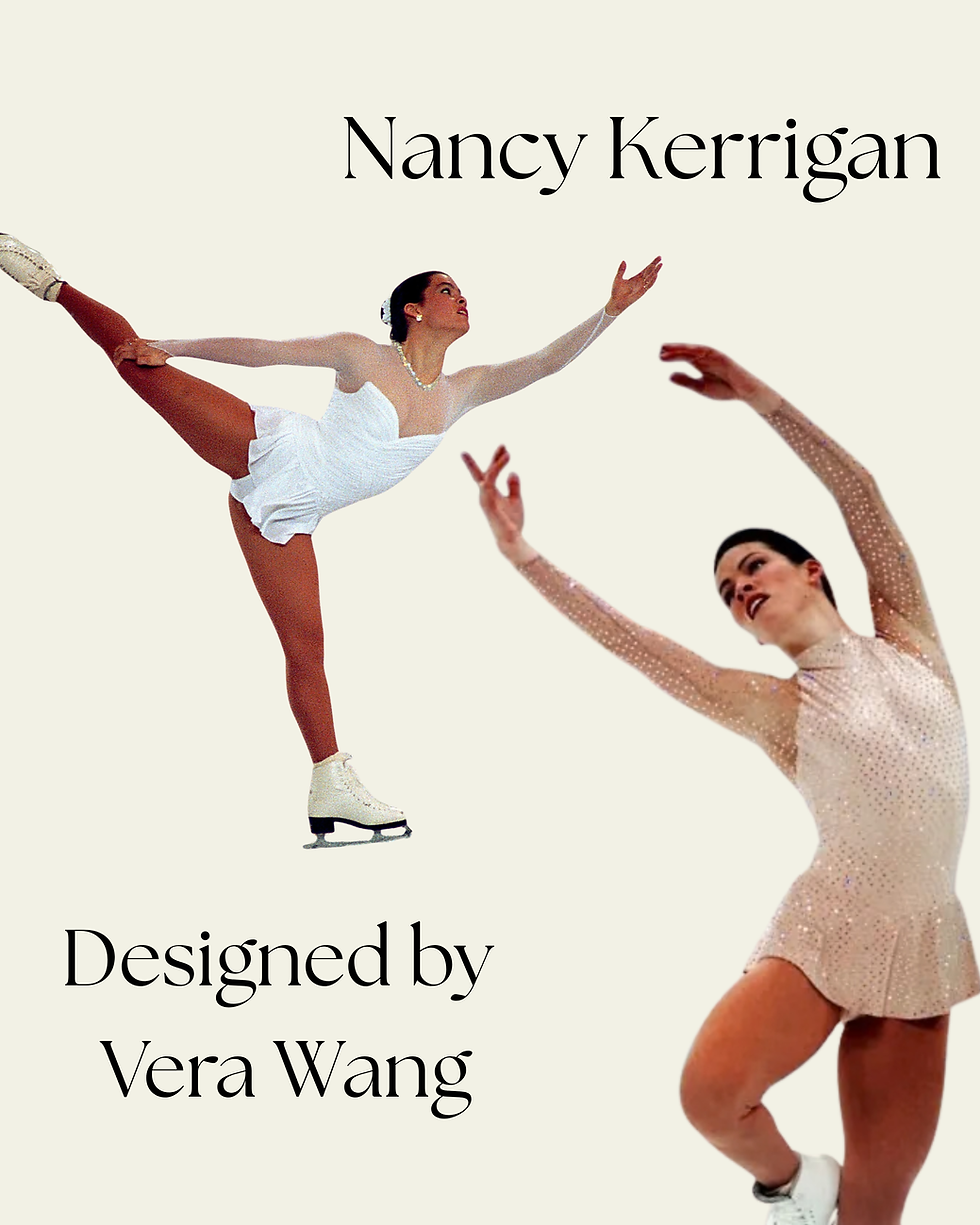
With Nancy Kerrigan, Vera Wang began to articulate what her version of ice couture could look like. In the early 1990s, Wang, a high-profile couture bridalwear designer, refined a design language rooted in restraint, precision, and an architectural understanding of the female form. Translated to the Olympic rink, that philosophy manifests in clean lines, illusion mesh, controlled silhouettes, and an absence of excess, which sharply contrasts with Lacroix’s maximalist look.
At Albertville in 1992, Wang’s approach with the all-white costume allowed Kerrigan’s skating to read as composed, prim, and proper, much like a prima donna dancing the part of the White Swan in Tchaivosky’s Swan Lake. Kerrigan’s look in Lillehammer 1994 doubled down on its simplicity, yet embraced a more editorial look with its illusion mesh and controlled 11,500 rhinestone whimsy. I personally love the Lillehammer costume; it looks like an outfit you’d see on a runway or at a red carpet event.
In both Games, Wang used Kerrigan as a canvas for unforgettable quiet elegance that refined spectacle rather than chasing it, and enhanced the skater’s performance. Her next designs with Michelle Kwan would only deepen the language of her designs, pivoting from restraint to feeling beyond the lines.

With Michelle Kwan, Wang refined her vision for couture on ice into something emotional and enduring. At Nagano in 1998, the American designer opted for more fluid lines, muted palettes, and an emphasis on movement over embellishment, aligning with Kwan’s lyrical, inward style. By the Salt Lake City Games in 2002, that couture language had matured into a quieter look that suited Kwan’s emotional musicality. In both Games, Wang treated the skated dress not as a spectacle but as an extension of music, body, and emotional narrative that didn’t announce itself loudly but instead lingered.
The periwinkle velvet dress, in my opinion, is as timeless as it gets as an objective fashion look; it is a quintessential 90s look, yet you might find it in someone’s wardrobe today.
Together, Christian Lacroix and Vera Wang defined what high fashion can achieve on the Olympic ice. Lacroix arrived once, as boldly and unapologetically as a supernova, and treated the rink as a stage for couture spectacle, proving that excess, identity, and sport can mingle beautifully. Wang, by contrast, stayed and refined her look and language over time, embedding couture into the mechanics of performance. One was a declaration; the other was a practice over time.
The fact that the collision of the fashion and figure skating worlds remains rare underscores the challenge: Olympic figure skating demands not just vision but humility before physics, regulation, and risk. There is no debate about whether fashion belongs on the ice, but which designer might step up to the challenge and accept the same constraints to create something just as, if not more, mesmerizing?
